
About the Gallbladder
The gallbladder is a small, pear-shaped organ located under the liver (right hypochondrium). Its main functions include:
- Storage of bile and concentrating it 5–10 times.
- Releasing bile into the duodenum during digestion, especially after fatty meals.
- Supporting fat digestion and absorption.
Gallbladder Stones (Gallstones / Cholelithiasis)
Gallstones are solid deposits that form inside the gallbladder, usually from cholesterol, bile pigments, or both.
Causes & Risk Factors
The “classic 4F’s” describe the common risk factors for gallstones:
- Female
- Fat (obesity, high-fat diet)
- Forty (middle age)
- Fertile (pregnancy, estrogen therapy)
Other risk factors: diabetes, rapid weight loss, hemolytic diseases, family history.
Types of Gallstones
- Cholesterol stones – most common, yellow-green in color, formed due to excess cholesterol.
- Pigment stones – black (seen in hemolysis, cirrhosis) or brown (infection, bile stasis).
- Mixed stones – contain cholesterol, calcium salts, and bile pigments.
Clinical Features
- Many gallstones are asymptomatic and discovered incidentally.
- Biliary colic: sudden, severe pain in the right upper abdomen or epigastrium, radiating to the back or shoulder, often after fatty meals.
- Other symptoms: nausea, vomiting, bloating, and indigestion.
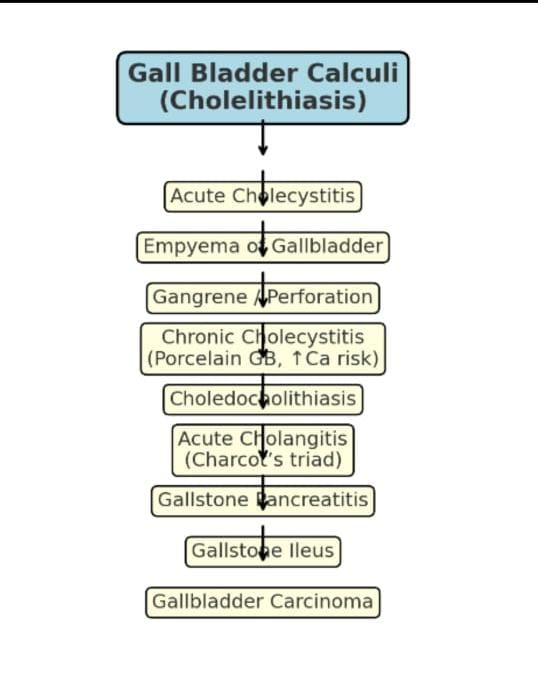
Complications of Gallstones
- Acute Cholecystitis – inflammation of the gallbladder due to duct obstruction.
- Empyema of Gallbladder – pus collection inside the gallbladder.
- Gangrene & Perforation – necrosis of the wall leading to peritonitis.
- Chronic Cholecystitis – recurrent inflammation causing fibrosis and porcelain gallbladder (increased cancer risk).
- Choledocholithiasis – gallstones in the common bile duct causing jaundice, cholangitis, or pancreatitis.
- Acute Cholangitis – infection of bile ducts (Charcot’s triad: fever, pain, jaundice).
- Gallstone Pancreatitis – stone blocks pancreatic duct causing pancreatitis.
- Gallstone Ileus – intestinal obstruction due to large gallstone.
- Gallbladder Carcinoma – rare but serious complication, often linked to chronic gallstones.
Diagnosis
- Ultrasound: first-line investigation for stones, wall thickening, fluid.
- CT / MRCP / ERCP: for complications and bile duct stones.
- Blood Tests: liver function, amylase, WBC count.
Management of Gallstones
- Asymptomatic gallstones: usually no treatment needed (except high-risk cases like porcelain gallbladder).
- Symptomatic gallstones or complications:
- Laparoscopic cholecystectomy (keyhole gallbladder surgery): gold standard treatment.
- ERCP: for stones in the common bile duct.
- Medical dissolution: ursodeoxycholic acid may be used rarely for patients unfit for surgery.